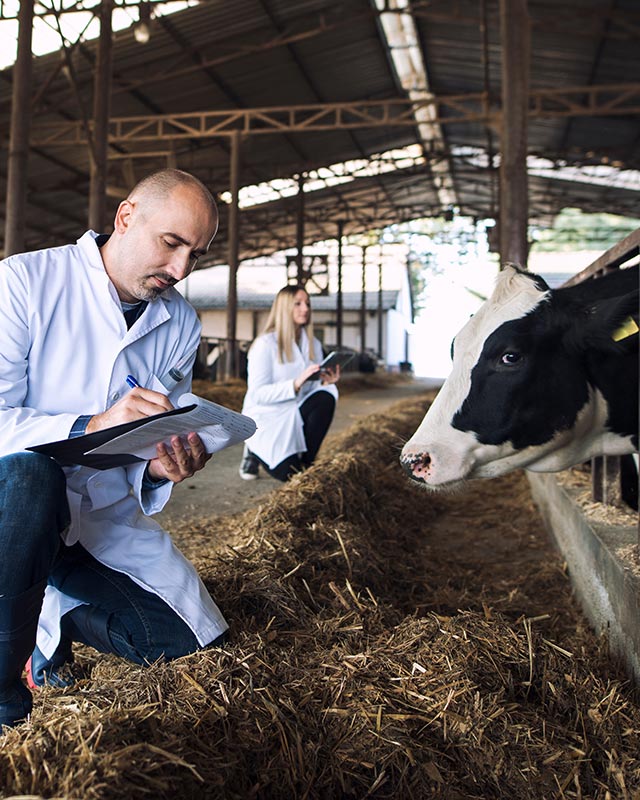



In this article, our National Technical Lead for Exports, Georgios Kakarantzas, provides an overview of our current understanding of the impending EU rules on prohibited antimicrobials applicable to imported animal products.
Background
Antimicrobial Resistance (AMR) was identified by the European Union (EU) as one of the three most significant global public health threats in 2023.
As part of its efforts to combat AMR, the EU has introduced strict restrictions on the use of antimicrobial medicinal products – including antibiotics, antivirals, antiprotozoals, and antifungals – in food-producing animals whose products are intended for export to the EU.
The Regulatory Framework
To support these public health objectives, the EU has introduced a tiered legislative framework:
• Regulation (EU) 2019/6 (Article 107): Prohibits the use of antimicrobials for growth promotion or yield enhancement within the EU.
• Commission Implementing Regulation (EU) 2022/1255: Establishes the specific list of antimicrobials strictly reserved for human medicine, effectively banning their use in food-producing animals.
• Commission Delegated Regulation (EU) 2023/905: Extends these identical antimicrobial requirements to live animals and products of animal origin exported to the EU from third countries.
Under Article 118 of Regulation (EU) 2019/6, non-EU countries must provide official guarantees demonstrating compliance to be included on the authorised exporting list. They must also confirm compliance via a specific attestation in their Export Health Certificates (EHCs).
Note on EHCs: While this attestation is already physically incorporated into current EHC templates, it remains crossed out as per footnotes of the EHCs until September 3, 2026.
Products Within Scope & Key Exemptions
The updated rules apply throughout the entire lifetime of the food-producing animal.
In-Scope Commodities
• Meat: Cattle, sheep, goats, pigs, horses, poultry, rabbits, and farmed game.
• Aquaculture: Fish, crustaceans, bivalve molluscs, echinoderms, tunicates, and gastropods.
• Other Animal Products: Milk, dairy products, eggs, casings, and honey.
Exemptions
• Gelatine, collagen, highly refined products (e.g., Vitamin D3), composite products, wild animals, and products derived from insects, frogs, snails, and reptiles.
• Animals and food transiting through the EU without being placed on the market.
• Products not intended for human consumption, or where the final EU destination is undetermined at entry.
• Product samples intended strictly for testing, analysis, or quality control.
Implementation Timeline: The “Cut-Off” Rule
The transition on September 3, 2026, relies strictly on the EHC signature date, not the animal’s slaughter date or the product’s manufacturing date.
The timeline below outlines how upcoming shipments will be handled based on certification dates:
• Pre-Deadline Shipping: On or before Sept 2, 2026
The EHC is issued and signed on or before 2 September 2026. Even if the consignment physically arrives in the EU on or after September 3, it is NOT required to comply with the new antimicrobial requirements.
• The Cut-Off Deadline: Sept 3, 2026
The transition date takes full effect. From this point forward, the antimicrobial attestation on the EHC becomes legally active and can no longer be crossed out.
• Post-Deadline Enforcement: On or after Sept 3, 2026
All certified consignments must fully comply. Imports will only be permitted if the exporting country is explicitly listed as authorised and the EHC attestation is certified.
The Brazil Delisting
To consolidate public health frameworks, the EU has moved the approved list of third countries into a new annex under Commission Implementing Regulation (EU) 2021/405, repealing the standalone Regulation (EU) 2024/2598. This consolidation was finalised via Commission Implementing Regulation (EU) 2026/1189, published in the EU Official Journal on 05 June 2026.
Only third countries with an approved residue monitoring plan listed in Annex -I to Regulation (EU) 2021/405 are eligible to be listed as compliant with the new antimicrobial requirements.
The Impact on Brazil
Critically, Brazil has not been included in the new ANNEX XVIa of Regulation (EU) 2021/405 (as amended by CIR 2026/1189).
The official justification is explicitly detailed in Recital (17) of CIR 2026/1189:
“Brazil is currently listed with an ‘X’ for bovine, equine, poultry, aquaculture, honey and casings. However, the Commission has not received information guaranteeing that Brazil implemented the necessary measures to ensure that the requirements laid down in Article 3 of Delegated Regulation (EU) 2023/905 will be complied with by 3 September 2026 for these categories. Therefore, the marking ‘X’ for bovine, equine, poultry, aquaculture, honey and casings should be deleted from the Annex to this Regulation.”
If the situation remains unchanged and Brazil fails to provide the necessary guarantees to the European Commission, the nation will be banned from exporting any in-scope animal products to the EU starting September 3, 2026.
When asked about a last-minute reversal during a recent EU webinar, DG SANTE highlighted the steep bureaucratic hurdles: “Under the most recent update of the approved country list, it has been agreed that Brazil will be delisted. I will not comment on the likelihood of Brazil being relisted before September. There are several steps in the listing process. The third country must first submit the necessary guarantees, which must then be assessed by the Commission… All of these steps take time.”
United Kingdom Status
The outlook for the UK remains stable. DEFRA has indicated that the UK anticipates a smooth transition. Domestically, bans on growth promoters and human-reserved antimicrobials have already been enforced for years.
An Animal and Plant Health Agency (APHA) Briefing Note is expected shortly.
UK certification will rely cleanly on its formal inclusion in the finalized EU compliance list.
Disclaimer: This information is accurate as of June 2026 and reflects the published regulatory text of CIR 2026/1189.
GEORGIOS KAKARANTZAS
E&J, Exports National Technical Lead