
Update
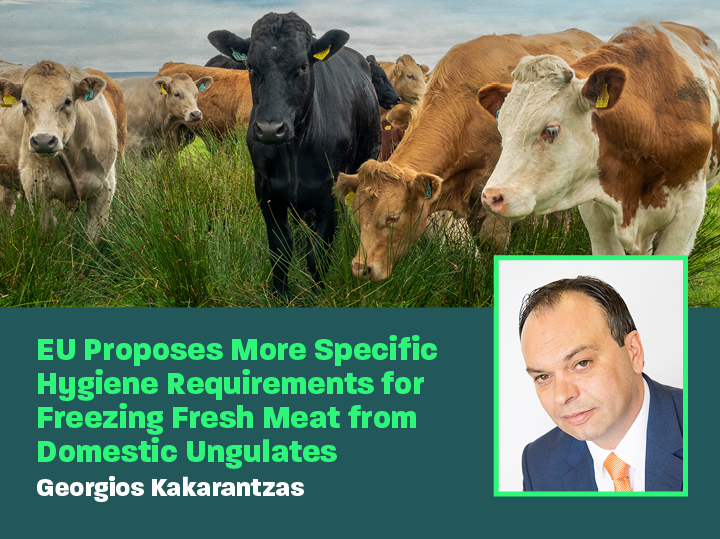
The European Union (EU) has notified the World Trade Organization’s Sanitary and Phytosanitary Measures (WTO SPS) Committee of proposed amendments to its food hygiene legislation. The amendments would introduce more specific requirements governing the time and temperature conditions for freezing fresh meat from domestic ungulates, including cattle, pigs, sheep, goats and horses.
Background
Regulation (EC) No 853/2004 lays down specific hygiene rules for food of animal origin applicable to food business operators. Under the current provisions in Annex III, Section I, Chapter VII, point 4, meat from domestic ungulates intended for freezing must be frozen without undue delay, taking into account, where necessary, a stabilisation period before freezing.
This stabilisation period allows the meat from domestic ungulates to reach a stable pH and core temperature before freezing.
On 3 December 2025, the European Food Safety Authority (EFSA) adopted a scientific opinion on the microbiological safety of ungulate meat intended for freezing and the defrosting of frozen ungulate meat. The opinion assessed the growth of relevant pathogenic, spoilage and indicator microorganisms under five scenarios involving chilling, storage and defrosting of bovine, ovine and porcine meat. Predictive microbiological models were used to assess different temperature conditions and, where possible, the effects of pH and water activity.
EFSA’s findings provide a scientific basis for replacing the current general requirement to freeze meat “without undue delay” with more specific time and temperature limits. The opinion also supports an alternative approach based on different time and temperature combinations, provided that the microbiological safety of the meat can be demonstrated.
However, EFSA was unable to assess meat from game ungulates or extrapolate its findings from domestic ungulates to game ungulates because of insufficient data. Consequently, the proposed amendments would not extend the new storage conditions before freezing to meat from even-toed farmed game mammals, for which the existing requirements would remain unchanged.
What is changing?
The European Commission proposes to introduce specific time limits for freezing fresh meat from domestic ungulates, depending on the temperature at which the meat is stored and transported immediately after slaughter.
Under the proposed amendments, meat intended for freezing would need to meet one of the following conditions.
Option 1: Storage and transport at a maximum of 7°C
Meat must be frozen within six days of slaughter, provided that it has been stored and transported at a temperature not exceeding 7°C immediately after slaughter.
Option 2: Storage and transport at a maximum of 3°C
Meat must be frozen within 14 days of slaughter, provided that it has been stored and transported at a temperature not exceeding 3°C immediately after slaughter.
Option 3: Alternative time and temperature conditions
Freezing may take place after storage and transport under other time and temperature conditions, provided that the food business operator supplies evidence, to the satisfaction of the competent authority, demonstrating the safety of the conditions applied.
This evidence must be based on an appropriate scientific assessment and include an evaluation of the presence and growth of pathogens and spoilage bacteria before freezing and after defrosting. The proposed amendments also address meat from even-toed farmed game mammals. For this category, the existing requirement to freeze meat without undue delay, taking into account where necessary a stabilisation period before freezing, would remain unchanged.
The proposed changes are set out in the draft Commission Delegated Regulation amending Annex III to Regulation (EC) No 853/2004.
Expected timeline
The EU intends to adopt the Regulation by the end of 2026, with the new requirements expected to apply from mid-2027. These dates remain indicative until the Regulation is formally adopted and its final application provisions are confirmed.
What does this mean for exporting countries?
The proposed amendments would replace the current general requirement to freeze meat “without undue delay” with two defined time and temperature combinations, alongside an evidence-based alternative.
Exporters of frozen meat from domestic ungulates may therefore need to review their chilling, storage, transport and freezing procedures to ensure compliance with the new requirements.
Businesses wishing to operate outside the specified combinations would need appropriate scientific evidence demonstrating that their chosen conditions maintain microbiological safety. This evidence would need to satisfy the relevant competent authority.
Although the proposed changes are intended to provide greater clarity, they could require some operators to reassess their existing processes.
Food business operators and exporters should monitor the progress of the proposed amendments and assess whether their current procedures will meet the requirements once the new rules become applicable.